

The outlook for Australia remains intact over the long term
We spent a recent morning at the Fordham Business Breakfast listening to Bernard Salt AM, and it was worth the early start. Most of us have spent the past month on the federal budget, and fairly so. Bernard pulled the lens back to the decade ahead. Underneath the noise, the structural story he laid out is one of the strongest in the developed world. Here is the longer version of what stood out, including the parts we did not have room for in the post shared on LinkedIn.
On the figures Bernard Salt presented, Australia has climbed from 24th to 11th in the world on GDP per capita over 30 years, and the next decade still looks unusually strong: more Australians at almost every age, growth concentrated in care, health and technology jobs and in regional and lifestyle towns, an aged-care 85-plus cohort growing toward roughly 62,000 people a year, India now the largest overseas-born community, and a Great Wealth Transfer building from the mid-2030s. Here is what stood out for anyone making a long-term decision.
The long look
Bernard has been writing about Australian demographics for 30 years, long enough to coin terms like KIPPERS (Kids In Parents' Pockets Eroding Retirement Savings) and PUMCINS (Professional Urban Middle Class In Nice Suburbs). The headline he kept returning to is that Australia has moved from 24th to 11th in GDP per capita over the past 30 years, the only large-population nation other than the United States near the top of those rankings. On the figures Bernard presented, the world is on track to add around 2 billion more people by mid-century, heading toward a peak near 10 billion, and much of the food, energy and resources to support that growth can come from here. A decade from now there will be more Australians in pretty much every single year of life than there are today. As Bernard put it, you do not get that in China, Russia, South Korea or Singapore. You get it in a safe, secure, aspirational Australia, so something worth reflecting on when the budget headlines get loud.
Where the growth actually lands
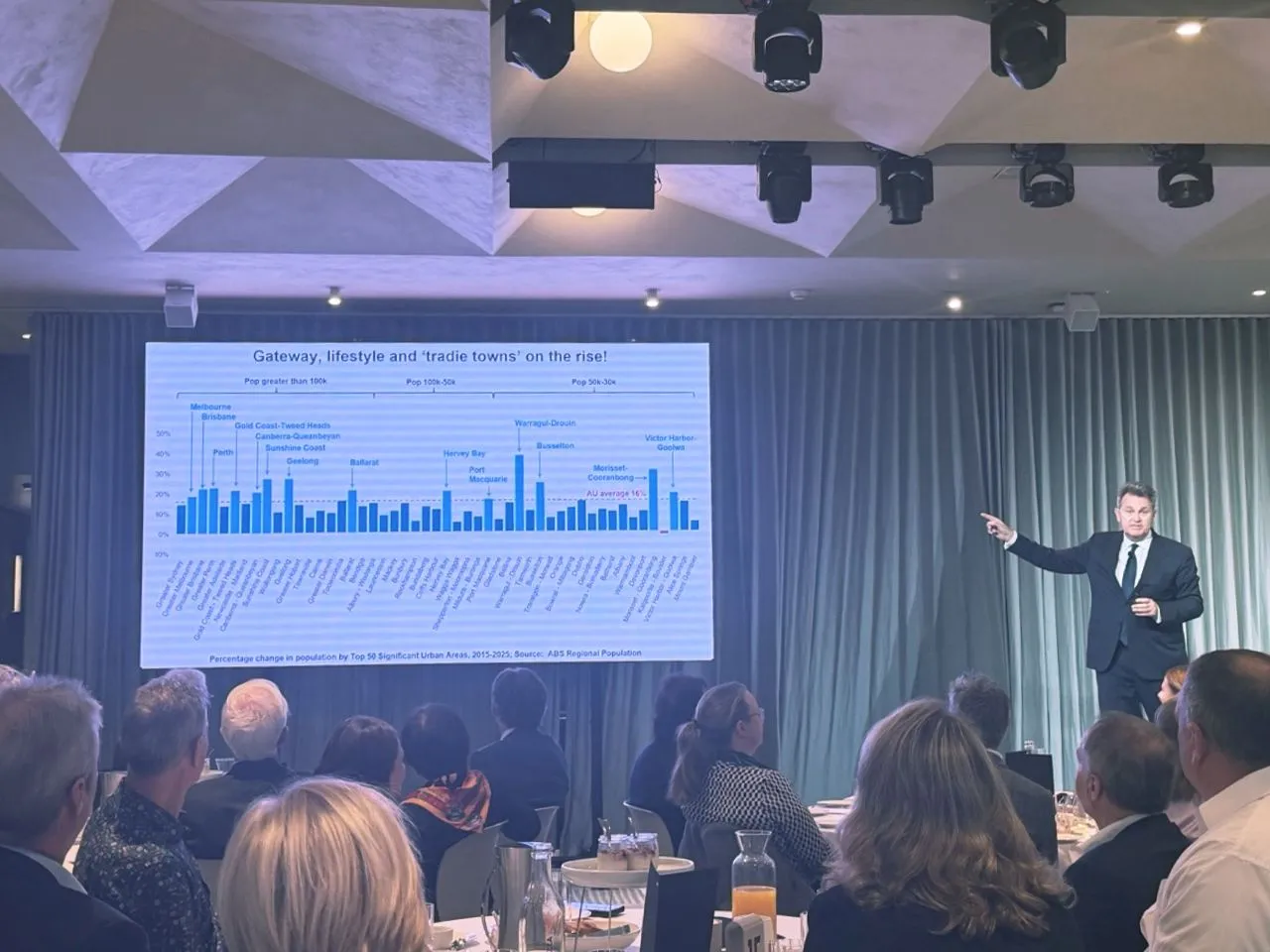
The growth is real, however it is not evenly spread, and that is the part that matters if you are buying a business or a commercial asset. Two shifts stood out. The first is the shape of the workforce. On the ABS figures Bernard set out, between February 2020 and February 2026 aged and disabled carers grew by 146,000 roles and registered nurses by 68,000, while software and app programmers added 90,000 and child carers 60,000. Over the same period checkout operators fell by 55,000, general clerks by 29,000 and packers by 23,000. The economy is tilting towards care, health and technology, and away from the routine roles being automated. The second shift is geography. Gateway, lifestyle and what Bernard called "tradie towns" are growing fastest, places like Warragul-Drouin, the Sunshine Coast, Geelong and Busselton, all well above the national average over the past decade. For a buyer, the sector and the postcode are doing a lot of the work.
Selected job gains and losses, Australia, Feb 2020 to Feb 2026 (change in number of workers). Source: ABS Labour Force (Detailed); analysis by The Demographics Group / Bernard Salt, presented at the Fordham Business Breakfast, 28 May 2026.
| Aged & disabled carers | +146,000 |
|---|---|
| Software & app programmers | +90,000 |
| Registered nurses | +68,000 |
| Child carers | +60,000 |
| Packers | -23,000 |
| Livestock farmers | -25,000 |
| General clerks | -29,000 |
| Checkout operators | -55,000 |
The aged-care freight train
That phrase is Bernard's, and it is a good one. The net annual growth in Australia's 85-and-over population runs from around 20,000 today toward roughly 62,000 a year by the early 2030s. That is a long, structural demand line sitting under aged care, in-home care, healthcare property and the supply chains around them. It is one of the clearest demand signals in the whole presentation, and it is already showing up in the businesses people bring to us. The operators with the most durable demand over the next decade tend to be the ones attached to care, health and the everyday services a growing, ageing population needs.
The migration engine
Australia's fertility rate sat at about 1.5 in 2024 (1.48, to be exact), below the replacement level, which means population growth and the workforce behind it will come from migration for decades. In 2025 India became the largest overseas-born community in Australia for the first time on record, narrowly ahead of England, followed by China, New Zealand and the Philippines. The fastest growth has come from India and Nepal, whose community has roughly quadrupled over the decade, with Pakistan also among the quick risers. The practical read is a bigger and more diverse domestic market, and a consumer base whose tastes are shifting with it. If you are acquiring a business that serves local communities, that mix is part of the demand picture, not a footnote to it.
Australia's largest overseas-born communities by country of birth, June 2025. India overtook England as the largest for the first time on record. Source: ABS, Australia's Population by Country of Birth (Jun 2025); ABS reports the UK nations separately.
| India | 971,020 |
|---|---|
| England | 970,950 |
| China | 732,000 |
| New Zealand | 638,000 |
| Philippines | 412,530 |
| Vietnam | 326,630 |
| South Africa | 229,950 |
| Nepal | 213,580 |
| Sri Lanka | 184,800 |
| Malaysia | 184,320 |
The wealth transfer reset
This was the thread we found most interesting for the people we work with. Bernard mapped what he called the Great Wealth Transfer building from the mid-2030s, as the Baby Boomer generation moves through. On the Fordham wealth advisory panel afterwards, one of the speakers put a number on a slice of it that Bernard had alluded to: roughly $3.2 trillion is expected to flow to women over the coming decade, around 65% of the total transfer. On Bernard's own numbers, the Baby Boomer generation is contracting by around 33,000 people a year now, building toward roughly 195,000 a year by the mid-2040s, which he estimates frees up about 6,000 dwellings a year today, rising toward around 146,000 a year by 2044. That reshapes who holds the capital, who needs advice, and what the pipeline of homes and business sales looks like over the next 15 years.
Noise versus signal
The budget changes are real, and for a lot of private business owners they are the most material set of changes in 30 years. They deserve the attention they are getting. However, on a 10-year view the structural story underneath is intact, and it is unusual in the developed world: a growing, ageing, increasingly diverse and still aspirational Australia. The noise is loud and worth understanding. The signal is worth further analysis if you're making a long-term, decade-length decision like buying a business or a commercial property. If you are weighing a decision of this magnitude, that is exactly the kind of conversation we enjoy having, and can help you navigate.
Questions this raises
What is Bernard Salt's outlook for Australia?
On the figures Bernard Salt presented at the Fordham Business Breakfast, Australia has moved from 24th to 11th in the world on GDP per capita over 30 years, and a decade out there will be more Australians at almost every age. He sees a growing, ageing, increasingly diverse and still aspirational country, an unusually strong structural position for a developed economy.
Which jobs are growing and shrinking in Australia?
On the ABS figures Bernard set out (Feb 2020 to Feb 2026), aged and disabled carers grew by 146,000 and registered nurses by 68,000, while software and app programmers added 90,000 and child carers 60,000. Over the same period checkout operators fell by 55,000, general clerks by 29,000 and packers by 23,000. The economy is tilting toward care, health and technology and away from routine roles.
What is the largest overseas-born community in Australia?
As of June 2025, India became Australia's largest overseas-born community for the first time on record, narrowly ahead of England, followed by China, New Zealand and the Philippines. The fastest growth has come from India and Nepal.
What is the Great Wealth Transfer, and why does it matter?
Bernard mapped a Great Wealth Transfer building from the mid-2030s as the Baby Boomer generation moves through. A figure raised on the Fordham wealth panel put roughly $3.2 trillion flowing to women over the coming decade, around 65% of the total. It reshapes who holds capital, who needs advice, and the pipeline of homes and business sales over the next 15 years.
Making a long-term decision?
Whether it is a business acquisition or a commercial property, the structure you put in place today has to work across the cycle ahead, not just this rate environment. If you want to talk one through, we are happy to help.